Quick decision
This guide assumes that optical media has already been selected. The separate AOC-versus-DAC resource covers the copper-versus-optical decision; this article compares two optical link architectures.
Choose an active optical cable when the route is bounded, both endpoint forms and port modes are known, a factory-integrated assembly is operationally acceptable, and replacing the complete end-to-end assembly is a manageable failure and upgrade action.
Choose pluggable optical transceivers with detachable passive fiber when the route belongs to structured cabling, the fiber must pass through panels or permanent pathways, the two optical endpoints need to be replaceable independently, or the organization wants the option to retain the installed fiber while changing modules. That last benefit is conditional: the next transceiver generation must support the fiber type, connector, polarity, channel loss and reach of the existing plant.
Neither architecture wins by speed label alone. Official portfolios show both 400G and 800G AOCs as real options, while other vendors deliberately omit AOCs from particular 100G-per-lane product families and recommend connectorized fiber. The correct question is not “Are AOCs available at 800G?” It is “Does the current host-supported product family provide the exact fixed or separable architecture required by this route, and what happens when one component fails or the link changes?”
The choice is between two maintenance boundaries
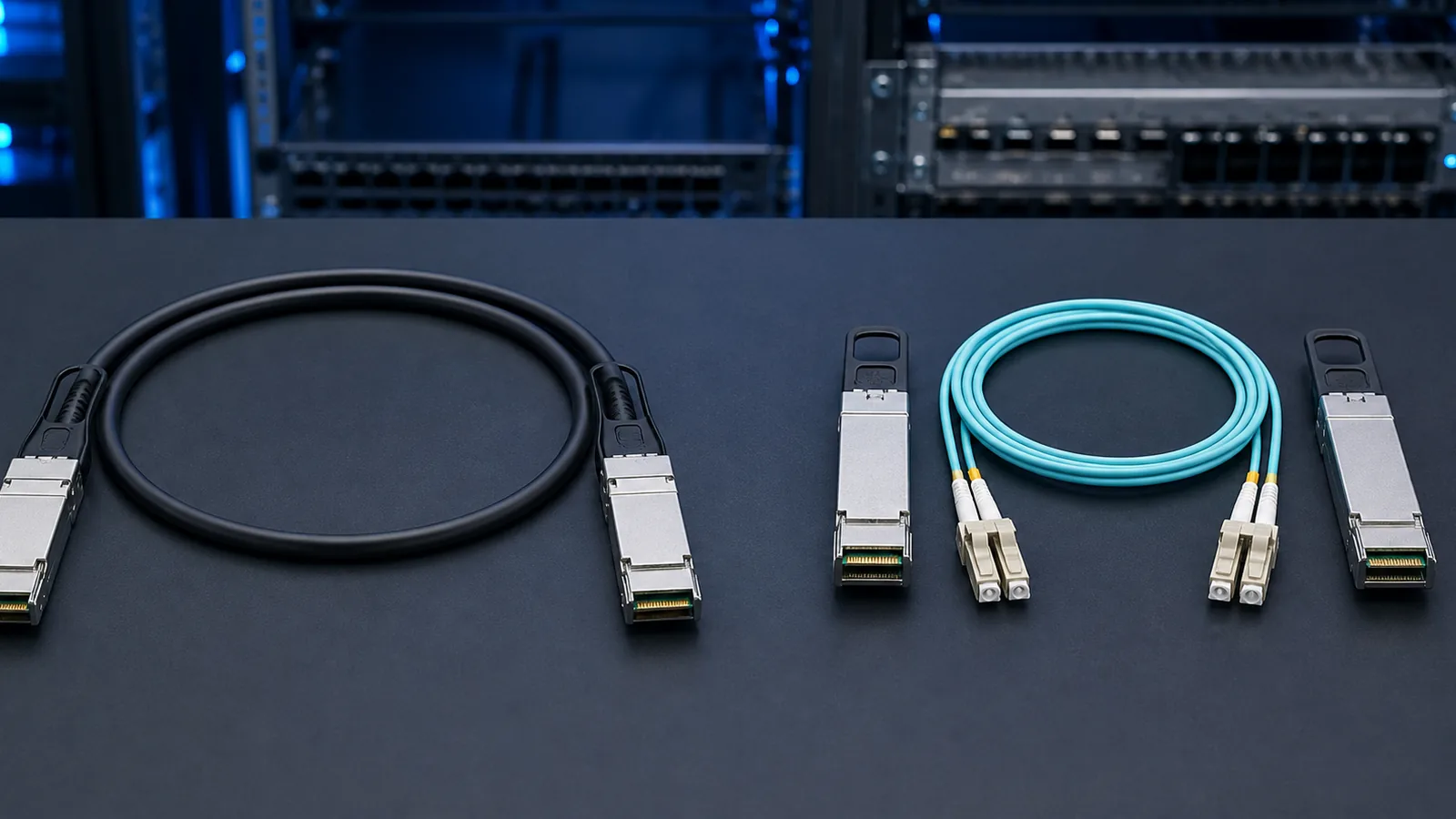
An AOC contains optical conversion electronics at its ends and a factory-attached fiber section between them. NVIDIA describes the fibers in its AOC architecture as bonded inside and not detachable. The assembly is installed, inventoried and replaced as one item. There are no field-mated optical interfaces between the AOC ends and its own fiber.
A pluggable architecture separates the link into at least three replaceable items: a transceiver at end A, a passive fiber path, and a transceiver at end B. The fiber path may itself include patch cords, panels, cassettes and a permanent trunk. This architecture creates more interfaces and more records, but it also lets operations isolate and replace an endpoint without automatically removing the entire route.
This difference defines the maintenance boundary:
| Decision area | Factory-integrated AOC | Pluggable transceivers plus passive fiber |
|---|---|---|
| Orderable unit | One fixed assembly, or one fixed breakout assembly | Two modules plus the documented fiber channel |
| Field optical connections inside the link | None between the AOC ends and its bonded fiber | One or more detachable optical interfaces |
| Failure replacement | Normally the complete fixed assembly | Failed module, jumper or trunk can be isolated and replaced separately |
| Route change | Limited by manufactured length and end geometry | Fiber segments and endpoints can be redesigned independently, within channel rules |
| Upgrade path | Complete AOC usually changes with the interface generation | Installed fiber may be retained only if the new PMD supports the existing channel |
| Procurement burden | Fewer component line items, but exact two-end identity is critical | More components and mating details, with a larger evidence and cleanliness burden |
This is not a universal cost ranking. A fixed assembly can reduce component count, while a separable architecture can reduce the scope of a future repair. Current purchase price, installation labor, spare quantities, expected moves and changes, and the cost of disturbing a live route all belong in the comparison.
Architecture A: what a fixed AOC simplifies
An AOC arrives with its optical engines and fiber assembled by the manufacturer. For a straight link, the buyer orders the form factor at each end, the supported aggregate rate, the length and the exact part number. For a breakout, the buyer also orders the branch count, branch rates, end forms and branch mapping.
The integration can simplify a bounded point-to-point deployment. There is no need to select two independent optical PMDs and a separate patch cord for the basic link. The factory controls the optical interfaces internal to the assembly. Installation does not require mating the AOC's internal fiber to its ends, and the complete item can carry one revision and serial identity.
Those benefits do not remove host-side questions. Each end still presents an electrical module interface to a switch, NIC, DPU or other device. The candidate must be supported for the specific host, port, software or firmware, form factor, port mode and breakout configuration. The host may perform FEC or require a particular lane configuration. A module being readable in management data is not proof that both ends will operate in the requested mode.
The fixed architecture also concentrates several risks in one item:
- if an optical engine, latch, attached fiber section or branch fails, the complete assembly normally becomes the replacement unit;
- a long cable may need to be removed through multiple managers or racks even when the suspected fault is at one end;
- the manufactured length cannot be shortened or extended with an ordinary field connector;
- a straight assembly cannot become a fan-out merely through host configuration; and
- a connector-form or protocol change at either endpoint can make the whole assembly unsuitable.
That is why an AOC works best where the path is known and accessible, the ordered length fits a stable layout, and a complete replacement does not create excessive disruption.
Architecture B: what separable pluggables add
With pluggable optics, each host receives a transceiver that terminates a passive fiber channel. The transceivers can be the same form factor or different forms at the two ends if the host support and optical media specifications permit that pairing. The link may use duplex LC, parallel MPO or another documented connector and fiber arrangement.
This architecture adds component-selection work. The two optical interfaces must be the same interoperable media type, not merely the same headline speed. Fiber type, connector end-face style, lane count, polarity, reach and channel loss must match the exact PMD requirements. The host electrical interface, FEC behavior, power class and management implementation must also be supported at both ends.
In return, the failure domain can be narrower. Cisco's data-center cabling white papers describe pluggable endpoints as field-replaceable: an operator can replace one or both transceivers without automatically replacing the installed fiber. That is a valuable operational option when the route crosses several racks or a structured cabling zone.
The option is not the same as a diagnosis. A link alarm does not establish that a transceiver is faulty, and a replaceable module should not be swapped blindly. The fault may be contamination, an incorrect patch, a channel-loss problem, a host configuration mismatch or damage elsewhere in the path. The separable design makes isolation possible; it does not make isolation automatic.
Pluggables also permit a fiber plant to outlive one module generation in some designs. Cisco uses lower-speed examples to explain the principle: retaining installed fiber while changing the endpoints can protect the infrastructure investment. For a 400G or 800G buyer, this should be written as a design objective, not a promise. A future module may require a different fiber count, connector, polish, polarity or loss limit. Reuse exists only when the new module's current data sheet and the measured channel agree.
Route geometry often decides before product price does
A short, open route inside one rack is different from a path that enters structured cabling, passes through overhead containment or terminates in another hall. Map the installed route before comparing catalog prices.
For an AOC, record:
- the actual pathway distance, not the straight-line rack spacing;
- service slack allowed by the site;
- connector dimensions and pull-tab clearance;
- minimum bend radius and maximum pull or crush limits from the exact data sheet;
- the largest end that must pass through the pathway;
- the breakout point and branch reach, if applicable; and
- whether the complete assembly can be removed without disturbing unrelated live links.
For pluggable optics and fiber, record the same physical pathway plus every planned mated pair, panel, cassette, splice and segment. The route must comply with the PMD's fiber and channel requirements. A distance within the advertised reach can still fail the design if connector loss, contamination or an incorrect fiber construction consumes the available margin.
Vendor distance tables are product-family evidence, not universal thresholds. Cisco's current 400G QSFP-DD data sheet, updated 3 March 2026, lists its QDD-400-AOC family at specific lengths from 1 to 30 meters and lists pluggable 400G options with different connectors and reaches. Arista's 800G Q&A lists its straight and 2x400G breakout AOCs at selected lengths from 1 to 30 meters, alongside pluggable 800G modules with multiple PMDs and reaches. Juniper's 800G guide also lists OSFP and QSFP-DD AOC part-number families from 1 to 30 meters.
Those examples prove that vendors offer particular products. They do not establish “30 meters” as the limit for all AOCs, nor do they qualify a third-party assembly on Cisco, Arista or Juniper equipment.
Serviceability: count the work, not only the parts
The operational comparison becomes clearer when the buyer writes a replacement procedure for each architecture.
For a fixed AOC, ask:
- Can both ends be taken out of service at the same time?
- How many racks, trays or bundles must be opened to remove the assembly?
- Can the connector bodies pass through the route without disassembling unrelated cabling?
- Does one failed branch require replacement of all branches?
- Where will a full-length spare be stored without violating bend limits?
- How will the removed assembly be identified for investigation?
For a pluggable link, ask:
- Can a suspected endpoint be isolated with host data and optical measurements?
- Are approved spare modules stocked for both endpoint platforms?
- Can the passive fiber be inspected and cleaned without exposing adjacent channels?
- Are patch-panel and branch records accurate enough to locate the affected strand?
- Is a replacement module allowed by the current host software and support matrix?
- Can the team verify the restored link without converting a temporary substitution into an undocumented permanent configuration?
The AOC may have fewer field interfaces, but its replacement scope is broader. The pluggable design has a narrower potential replacement scope, but more interfaces to inspect and more component relationships to control. Neither is “easier” without the route and operating model.
Connector exposure changes the inspection workload
A factory-integrated AOC removes the detachable optical mating points between its embedded optical engines and attached fiber. This reduces the number of internal optical faces that installers handle in the field. It does not make the assembly maintenance-free. The electrical module ends still need correct ESD handling, dust protection while stored, mechanical inspection, bend and pull control, and careful routing. Damage to the bonded fiber or a sealed optical end is not repaired by cleaning a patch cord.
Pluggable transceivers expose the optical receptacles and the mating patch-cord ends. Each field connection adds an identity and cleanliness requirement. Cisco's transceiver-maintenance guidance uses an inspect-and-clean process for fiber interfaces and warns that contaminated connections can damage components. The exact cleaning tool must match LC, MPO or another connector; APC and UPC interfaces must not be treated as interchangeable; and dust caps are protection devices rather than proof of cleanliness.
This difference should appear in the labor and evidence model. The AOC installation record needs assembly condition, route and end identification. The separable link additionally needs connector and patch identity, inspection and cleaning records, and an optical channel record appropriate to the PMD. Fewer exposed mating points may reduce one maintenance task, while field-replaceable modules improve another. Those advantages coexist and should not be collapsed into an unsupported claim that one architecture has a universally higher reliability or MTBF.
Breakout architecture is a separate decision
At 400G and 800G, many purchases are not straight one-to-one links. A high-rate switch port may serve two 400G endpoints, four 200G endpoints, eight 100G endpoints or another supported combination. The aggregate rate printed on the switch-side connector does not define the branch architecture.
An AOC breakout fixes the optical engines, fiber legs, connector forms, branch lengths and mapping into one assembly. This can reduce the number of separately ordered items. It also means a branch problem may affect the service decision for the complete assembly, and the branch geometry cannot be reconfigured like a patch-panel design.
Pluggable optics may expose multiple optical ports from one module or use parallel fiber that is broken out in passive cassettes or harnesses. For example, Arista's 800G Q&A documents 800G pluggables that provide two distinct 400G optical links and other modules that can support lower-rate breakouts with the appropriate optical architecture. These are Arista-specific product examples, not a generic feature of every 800G module.
For either approach, the procurement record must state:
- aggregate host port rate;
- number and rate of logical branches;
- electrical lane mode and required host configuration;
- form factor at the aggregate and branch ends;
- branch identifier and destination port;
- protocol and optical or cable media type;
- whether the branch length is common or independently specified; and
- the current manufacturer part number supporting the exact topology.
Do not allow “800G to 2x400G” to stand alone. It does not say OSFP or QSFP-DD, QSFP112 or another branch form, Ethernet or InfiniBand, AOC or passive-fiber architecture, or which PMD is used.
400G evidence: compare real families without generalizing
Cisco's 400G QSFP-DD portfolio is useful because one official data sheet places AOC and multiple pluggable architectures side by side. The QDD-400-AOC family is a fixed active optical assembly offered in listed lengths. The same portfolio contains pluggable modules using MPO or LC and single-mode or multimode fiber for different reaches and media specifications.
The correct lesson is that “400G” admits multiple physical architectures. It is not that one Cisco row sets the design limits for the market. Cisco certifies the named products on the named Cisco ports; that statement does not transfer to a PhotonVerge candidate. Even within the same data sheet, connector, power, breakout and FEC details vary by product.
A 400G buyer should therefore compare equivalent duties:
- the same two hosts and port modes;
- the same route and service slack;
- the same required logical links and breakout;
- the same environmental and installation constraints; and
- the same evidence status.
Only then should price and spare quantity be compared. An AOC quotation for a short fixed route and a pluggable quotation for a structured 2 km channel are not alternatives to the same requirement simply because both say 400G.
Cisco's 2021 architecture papers can support the maintenance distinction between fixed cables and field-replaceable endpoints. Their example speeds and cost observations are historical and should not be copied as current 400G or 800G limits or pricing rules.
800G evidence: availability is portfolio-specific
It is unsafe to say that 800G AOCs do not exist. Arista's official 800G Q&A lists straight AOCs in OSFP-to-OSFP and QSFP-DD-to-QSFP-DD forms and breakout AOCs to two 400G QSFP112 ends, with listed lengths from 1 through 30 meters. Juniper's official 800G cable guide lists OSFP and QSFP-DD AOC families over a similar set of catalog lengths.
It is equally unsafe to say that every 800G platform supports AOC. NVIDIA's 100G-PAM4 LinkX documentation states that its portfolio does not offer AOCs for those 100G-PAM4 Ethernet or InfiniBand systems, except for specifically described backward-compatibility AOC configurations. NVIDIA explains that its AOC fibers are bonded and that the size and weight of multi-ended OSFP assemblies create installation concerns; it recommends connectorized fiber for complex infrastructure and future line-rate changes.
These sources are not contradictory once their scope is preserved. Arista and Juniper document actual 800G AOC product families. NVIDIA documents a different portfolio and architecture decision. A buyer should never convert a vendor's “not offered in this series” into an industry-wide impossibility, or convert another vendor's product list into proof that a different platform supports the same architecture.
Form factor also remains separate from optical media. Arista notes that OSFP and QSFP-DD are physically distinct; one cannot be inserted into the other's port. The company also explains that different form factors can operate across a link when the optical media types and platform conditions match. That is an Arista-context interoperability statement, not permission to pair arbitrary modules. The exact PMD, host support, FEC and management requirements still control.
Upgrade value depends on the fiber channel, not the word “pluggable”
The strongest strategic argument for pluggable optics is the possibility of preserving passive infrastructure. It is only a possibility.
Before calling a fiber plant “upgrade-ready,” document:
- single-mode or multimode fiber type and grade;
- fiber count and usable strands;
- connector type and end-face style;
- polarity and lane mapping;
- each patch point, splice and cassette;
- measured insertion loss and any applicable reflectance evidence;
- route length and environmental constraints; and
- the future PMD candidates the design is intended to support.
When the upgrade arrives, repeat the comparison against the new module's current requirements. If the next PMD changes from duplex to parallel fiber, from MPO-12 to MPO-16, from UPC to APC, or to a tighter channel budget, the existing plant may not be reusable even though both endpoints are pluggable.
An AOC makes the upgrade boundary explicit: the fixed assembly is normally changed as a unit. That can be acceptable in a pod designed for coordinated replacement. It can be undesirable in a permanent route where pulling a new assembly is disruptive. The answer depends on expected equipment life, change frequency and physical access, not on a generic sustainability or future-proofing claim.
Avoid asserting environmental benefits without measured product and deployment data. Reusing a fiber path may avoid replacement work, but a valid lifecycle comparison would also need the embodied and operating impacts of modules, cables, spares and field activity. The sources cited here do not establish a universal environmental winner.
Power, cooling, FEC and management stay product-specific
Both AOCs and pluggable transceivers contain active electronics at the host interface. Their power and heat cannot be inferred from the word “optical.” Use the exact candidate data sheet and the host's per-port power and thermal guidance.
For dense deployments, record:
- maximum and typical power where the manufacturer provides both;
- allowed module power class;
- airflow direction and ambient assumptions;
- adjacent-port loading restrictions;
- connector and pull-tab clearance;
- host FEC responsibility and configured FEC mode; and
- supported management revision and diagnostic fields.
Do not state that AOC is automatically cooler than two pluggables or that a pluggable solution always consumes more. The comparison depends on the designs being quoted. Cisco's 400G table, for example, publishes product-specific power values; those numbers apply to Cisco product IDs and cannot be copied onto a third-party candidate.
Management data should be treated as evidence with limits. Module identity, temperature, voltage and alarms can support commissioning and diagnosis where the product exposes them. They do not certify end-to-end interoperability. An integrated AOC may report two ends or an assembly identity differently from independent modules; the buyer should define which records are required rather than assume a common telemetry model.
Diagnostics are not exclusive to pluggable optics. An archived, release-specific BlueField-3 table for DOCA 3.0.0 lists real-time digital diagnostics for certain AOC revisions; it is historical evidence for those named entries, some of which also carry lifecycle states, not a current support matrix. Cisco separately documents CMIS, VDM and firmware-management capabilities for particular 800G pluggable modules. These examples show why the RFQ must request the management fields and revision for the exact candidate. They do not prove that every AOC exposes full diagnostics or that every pluggable has the same telemetry.
Build the commercial comparison around lifecycle events
A useful total-cost worksheet does not begin and end with unit price. Model the events that could occur during the planned service life:
Initial deployment
Include modules, fiber assemblies, panels or cassettes, installation labor, inspection and cleaning, labeling, test time, pathway use and required spare stock. For an AOC, include the handling burden of pulling large ends and storing long spares. For pluggables, include the additional field interfaces and documentation.
Single-end fault investigation
Estimate how the fault will be isolated, which components may be substituted, and whether one endpoint can be replaced without moving the route. Do not assume every alarm is a module failure.
Cable or trunk damage
For AOC, the complete assembly is normally the replacement boundary. For a separable design, the damaged segment may be replaceable while retaining modules, but only if the fault has been localized and replacement preserves the approved channel.
Rack move or topology change
An AOC's fixed length and branch construction may require a different assembly. A modular fiber route can be repatched or extended only within the PMD channel constraints and facility rules.
Speed or platform upgrade
For AOC, plan for a new supported assembly. For pluggables, test the proposed new endpoints against the existing fiber records before assigning reuse value. If the connector or channel changes, include the plant modification.
Obsolescence and substitutions
Track manufacturer part-number lifecycle and supported replacements. A same-speed substitute can differ in form, power, firmware behavior or media specification. Require a reviewed evidence update before changing the approved BOM.
This event-based model may show that a factory-integrated cable is preferable for one row and a separable architecture for another. A single data center does not need one universal answer.
Three decision patterns
Pattern 1: a stable, accessible short row
Two supported ports are in a known rack or adjacent-rack position. The route will not enter a permanent panel system, both ends can be taken down together, and a full spare can be installed without disturbing unrelated links. A vendor-supported AOC may reduce line-item and field-interface complexity. The buyer still verifies exact end forms, length, port mode, power, branch mapping and part number.
Pattern 2: a route through structured cabling
The link crosses zones, uses permanent pathways or must terminate at panels. Operations need endpoint-level replacement and a documented as-built fiber plant. Pluggable transceivers with the correct passive fiber architecture are usually the design to evaluate first. The buyer controls connector finish, fiber type, polarity, loss, cleanliness and host support.
Pattern 3: an 800G fan-out with frequent endpoint changes
One high-rate switch port serves multiple lower-rate devices whose positions or maintenance windows may change independently. A breakout AOC can be appropriate when the exact supported product and fixed branch geometry match the deployment. A pluggable and passive-breakout architecture may be preferable when branch repatching or endpoint replacement flexibility is more valuable. The decision requires a real port map and supported part-number set; “800G breakout” is not sufficient.
These patterns are decision frames, not product recommendations. No architecture should be approved until current platform documents and the candidate data sheets resolve every endpoint.
What the buyer should put in the decision record
For each route, retain:
- source and destination device, slot, port, software and firmware;
- protocol, aggregate rate, branch rates, lane mode and FEC;
- connector/form factor and cooling form at each host;
- surveyed pathway, service slack and selected order length;
- fixed AOC or separable transceiver-and-fiber architecture;
- exact manufacturer part number and lifecycle status for every active component;
- supplier SKU kept separate from the OEM or manufacturer identity;
- fiber type, count, connector finish, polarity and channel-loss record for a separable link;
- branch IDs and destination mapping for a fan-out;
- power, thermal, bend and clearance limits from the exact data sheet;
- current host support or compatibility evidence and access date;
- spare class and replacement scope;
- unresolved assumptions and the owner responsible for closing them; and
- agreed commissioning records without claiming a test has already passed.
A quotation response should fill these fields rather than replace them with “compatible 400G” or “800G AOC.” If evidence is absent, mark it not confirmed. That is more useful than a confident but unauditable statement.
For the earlier media decision, use the AOC vs DAC guide. If the remaining question is cage format rather than service architecture, use the 800G OSFP vs QSFP-DD guide. A separable parallel-fiber design should carry the MTP/MPO polarity record, while either architecture still needs the compatibility evidence checklist.
Send the route for an architecture review
Submit both endpoint models and software releases, the surveyed route and patch-panel geometry, port/breakout map, maintenance window, spare strategy, candidate manufacturer part numbers, quantity and expected upgrade horizon. WUHAN SUNFULL can return a fixed-AOC versus separable-optics comparison with evidence gaps called out; final platform support remains subject to the named host and product documentation. Send the route and BOM context.
Conclusion
AOC and pluggable optics solve different operational problems. The AOC is a factory-integrated, fixed assembly that can simplify a stable point-to-point link. Pluggable transceivers separate the active endpoints from the passive fiber, expanding the design and documentation burden but allowing component-level service and conditional reuse of the fiber infrastructure.
At 400G and 800G, neither availability nor suitability is universal. Cisco documents both 400G AOC and pluggable families. Arista and Juniper document 800G AOCs. NVIDIA omits AOCs from a particular 100G-PAM4 portfolio while retaining limited backward-compatibility assemblies and explaining why it favors connectorized fiber there. Each statement remains valid only inside its vendor, product and protocol boundary.
For buyers, the defensible choice comes from the route, endpoint support, breakout map, replacement procedure and upgrade plan. Once those are explicit, the exact part numbers can be evaluated with evidence instead of being guessed from a speed and connector label.
Primary sources
- Cisco, Distributed Cloud Computing and its Impact on the Cabling Infrastructure within a Data Center — updated 13 May 2021; fixed cable versus field-replaceable pluggable maintenance and upgrade principles.
- Cisco, A Move to High Speed Server Connectivity in the Cloud — updated 2 December 2021; field-replaceable endpoint and retained-fiber architecture examples at the speeds covered by that paper.
- Cisco, 400G QSFP-DD Cable and Transceiver Modules Data Sheet — updated 3 March 2026; product-specific 400G AOC and pluggable examples.
- Arista, 800G Transceivers and Cables Q&A — document 04-0046-06, December 2025; 800G straight and breakout AOCs plus pluggable examples.
- Juniper Networks, Cable Types and Length — dated 8 August 2025; OSFP and QSFP-DD AOC product families.
- NVIDIA, Copper DAC and LACC Cables Overview — last updated 18 November 2025; bonded AOC construction, limited backward-compatibility AOCs and connectorized-fiber rationale for NVIDIA's 100G-PAM4 portfolio.
- NVIDIA, LinkX 100G-PAM4 Product Line Overview — last updated 18 November 2025; portfolio scope, connector forms and backward-compatibility context.
- Cisco, Maintaining Transceivers and Optical Cables — updated 31 July 2026; platform-scoped optical inspection and cleaning guidance.
- Cisco, OSFP 800G Transceiver Modules Data Sheet — document C78-4883800-02, January 2026; product-specific 800G PMD, host-FEC and management examples.
- NVIDIA, BlueField-3 Validated and Supported Cables and Modules — archive updated 24 December 2025; platform- and revision-scoped AOC diagnostic examples.