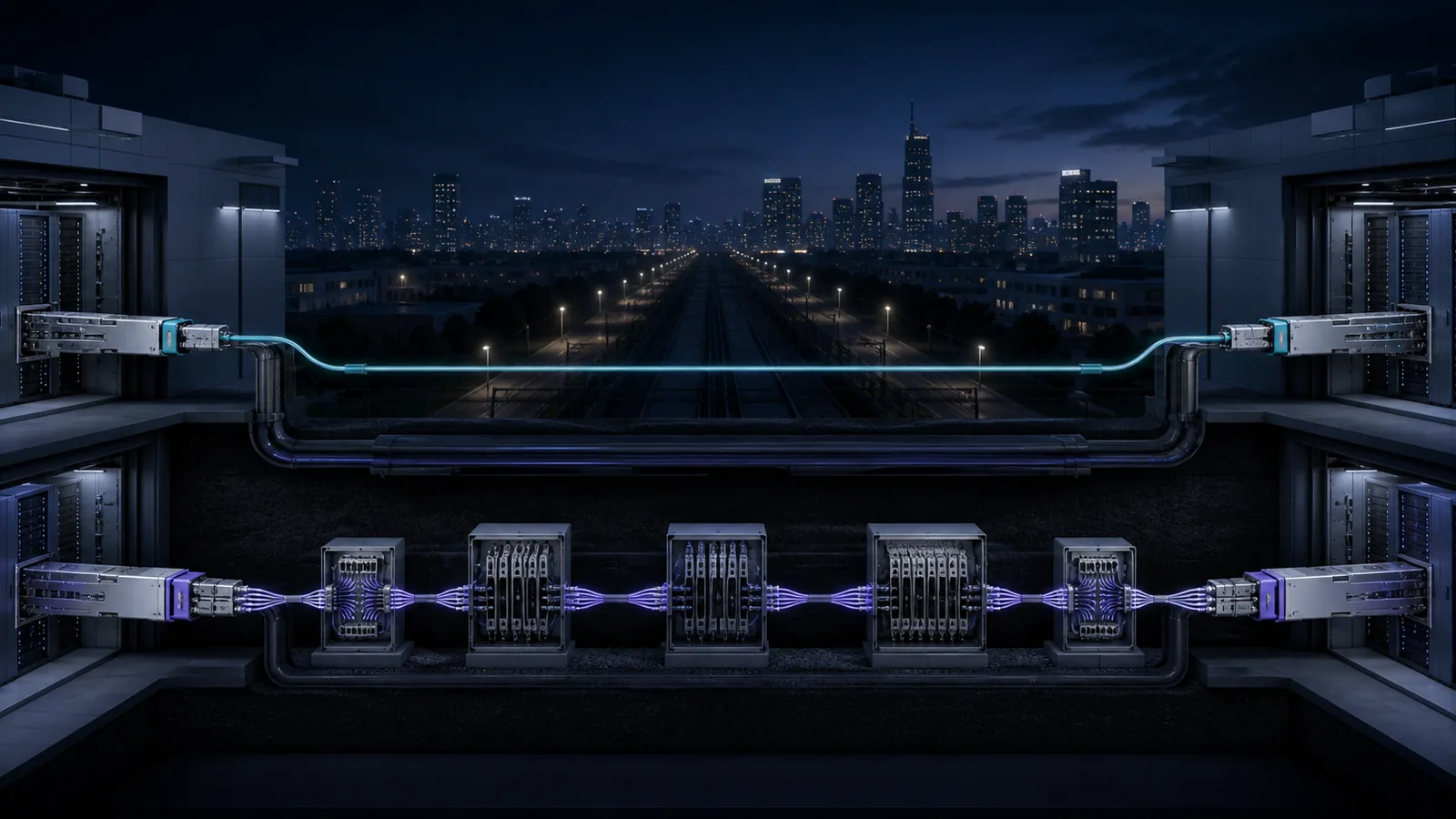
A buyer should not begin a 400G data-center interconnect by asking for “a 400G optic that reaches the distance.” The first decision is architectural: will the fiber carry a client optical signal directly between two Ethernet ports, or will it carry a coherent wavelength that must operate within a DWDM line environment?
For a clean point-to-point campus route within the named direct-detect PMD limit, client optics such as 400GBASE-FR4, 400GBASE-LR4-6 or a separately specified 400G-LR4-10 implementation can be the simpler choice. For a point-to-point metro route whose wavelength, amplification and impairment conditions fit a named OIF application code, 400ZR becomes a different class of answer. A path containing ROADMs or needing modes outside that base envelope belongs in a wider line-system review. OpenZR+ extends the coherent discussion to additional rates, modulation modes and higher-performance network applications, but it is not a universal substitute for 400ZR and it is not a synonym for every product marketed as “ZR+.”
That distinction changes the BOM. It also changes who must approve the route, what the host must support, what instruments are needed, which alarms matter, how spares are managed, and what evidence belongs in the purchase order.
Start with the route, not the module label
The following table is a screening tool, not a design approval.
| Route condition | Direct-detect client optics are usually the first path to examine | OIF 400ZR deserves a formal route review | OpenZR+ deserves a formal route review |
|---|---|---|---|
| Typical problem | A dedicated duplex fiber link between two known Ethernet endpoints | A 400GbE service carried as a coherent DWDM wavelength | A coherent service needing modes or operating envelopes beyond the base 400ZR application |
| Reach language | Use the exact PMD, not “short reach” or “long reach” | Codes 0x01 and 0x03 cover amplified point-to-point DWDM without an OADM, described as 120 km or less with a target reach of at least 80 km; code 0x02 is a separate unamplified case | Reach depends on the selected OpenZR+ media mode, FEC, launch power, line system and route impairments |
| Fiber environment | Usually a dedicated client link with a conventional channel-loss calculation | May be unamplified or may traverse amplifiers and a defined DWDM channel | Frequently considered for regional or line-system use where several selectable coherent modes matter |
| Host requirement | Correct Ethernet PMD, form factor, lane/FEC mode and software support | Host must explicitly support the coherent module, power/thermal class, application code and management behavior | Host and software must support the intended OpenZR+ mode, not merely recognize the module |
| Operational skill | Ethernet port, fiber inspection and client-optics troubleshooting | Wavelength plan, coherent telemetry, OSNR/line-system awareness and escalation ownership | Same coherent disciplines, with additional mode and interoperability controls |
| Procurement risk | Buying by an ambiguous FR4/LR4 label or ignoring channel loss | Assuming a QSFP-DD/OSFP coherent module behaves like a client optic | Buying a product called “ZR+” without a named OpenZR+ specification, mode and host record |
Distance is only one column because it is rarely the decisive column by itself. A nine-kilometre dedicated dark-fiber route and a nine-kilometre path through filters, amplifiers or an operator-managed DWDM system are not equivalent purchase problems. OIF-400ZR-03.0 defines three application codes across two route families. Codes 0x01 and 0x03 cover amplified point-to-point DWDM links without an OADM, described as 120 km or less and with a target reach of at least 80 km; feasibility remains OSNR- and impairment-limited.
The first worksheet: eight facts procurement must obtain
Before requesting prices, the buyer should require a route worksheet with eight entries. If an entry is unknown, write TBC and assign an owner. A blank field should never be silently converted into a supplier assumption.
1. Name both endpoints completely
Record chassis, line card or fixed system, port number, port form factor, software release and any hardware revision that affects module support. “Cisco to Arista” or “two 400G switches” is not enough. A module can fit the cage yet exceed the available power, require a management feature the host does not expose, or remain unsupported in the installed software.
The endpoint record must also state whether the port is intended to present ordinary 400GbE client behavior or a coherent application. If a router has a coherent-capable port, that capability may still be restricted to particular modules, application codes or releases.
2. Identify who owns the fiber and line system
Ask whether the path is customer-owned dark fiber, leased dark fiber, a managed wavelength, or a service delivered through an operator network. Then list every known passive and active element: patch panels, connector pairs, splices, mux/demux filters, ROADMs, amplifiers, protection switches and monitoring taps.
Direct-detect procurement normally treats these elements as channel loss and reflection contributors. Coherent design must also consider the line system as a frequency-selective, noise-adding and impairment-bearing environment. The same physical fiber can support different architectures, but the evidence needed to approve them is different.
3. Separate route length from route loss
A map distance is not an optical budget. For direct-detect links, record measured or designed attenuation, connector and splice loss, wavelength-dependent limits and operating margin. For coherent links, retain loss information but also capture the line-system assumptions used by the chosen application: amplification, channel spacing, filter path, launch conditions and the performance margin exposed by the host or planning tool.
Application code 0x02 is the unamplified, single-wavelength case. OIF Table 19 describes its reach as an 11 dB loss budget after accounting for link impairments; 11 dB is therefore neither a distance rating nor blanket approval for a measured-loss result. Connector reflectance, dispersion, implementation limits and the actual module/host combination remain part of the decision.
4. State the service and protection requirement
Write the payload, committed rate, acceptable outage window and protection model. Is this a single 400GbE point-to-point link? Must it use a protected pair? Will traffic be rerouted at Layer 3, or does the optical layer need a protection mechanism? Does maintenance require hot spares at both sites?
These questions influence architecture and cost more than a one-line module comparison. Direct-detect links can be operationally attractive when the service is simple and spare replacement is familiar. Coherent pluggables can reduce external transponder layers in the right IP-over-DWDM design, but they also move transport functions into router or switch ports. The organization must be ready to own those functions.
5. Name the standard or MSA mode
For direct detection, write the complete PMD: for example, 400GBASE-FR4 or 400GBASE-LR4-6. Do not collapse these into “400G LR4.” If the requirement is based on the 100G Lambda MSA 400G-LR4-10 specification, say so and record the revision.
For coherent, specify OIF-400ZR-03.0 and the applicable application code, or specify OpenZR+ MSA v3.0 and the intended media interface/mode. A seller’s generic ZR+ label is not sufficient. The OpenZR+ MSA itself warns that the broader ZR+ term is used inconsistently in the market. A purchase record needs the interoperable target, not a marketing category.
6. Record the wavelength and channel plan
A grey client optic does not require the buyer to provision a DWDM frequency channel. A coherent optic does. The worksheet should show the requested frequency or channel, channel spacing, fixed or tunable behavior, mux/demux port, line direction and any guard-band or operational restrictions supplied by the line-system owner.
OIF 400ZR Revision 3.0 includes defined 100 GHz and 75 GHz DWDM applications as well as optional flexible-grid provisioning. That does not mean every coherent module supports every grid option in every host. The module application advertisement, host software and operator plan must agree.
7. Assign telemetry and alarm ownership
Decide who will monitor optical power, temperature, module state, FEC/error indicators and coherent performance values. C-CMIS 1.4 extends CMIS and is used with it. Individual controls and performance monitors have to be checked against the module's advertised implementation and the host software because not every monitor is mandatory or exposed by every platform. A management interface can standardize data representation, but it does not create an operating process.
The runbook needs alarm thresholds, polling or collection method, baseline values, escalation contacts and a statement of which system is authoritative. If the network team cannot retrieve the coherent metrics that the acceptance plan depends on, the project is not ready for a production order.
8. Define acceptance before selecting a vendor
Write the acceptance conditions before samples arrive. Include link initialization, traffic duration, error and FEC observations, restart recovery, temperature/power behavior, alarm handling and any line-system performance checks required by the optical engineer. Include both endpoints and preserve software versions.
For multi-vendor coherent operation, a logo or MSA statement is not a substitute for a tested combination. OIF and OpenZR+ specifications are interoperability targets; the project still needs evidence that the selected host, module revisions, line path and operating mode work together.
Why direct detection is often the better purchase
Direct-detect optics deserve to be the default screening path when the route fits a defined client PMD and there is no business requirement for a managed DWDM wavelength. The architecture can be easier to explain, commission and support because each endpoint behaves as an Ethernet client port and the passive path can often be described with conventional fiber-loss records.
That simplicity has practical procurement value:
- fewer mode and channel-planning fields in the BOM;
- less dependence on a coherent-capable host software stack;
- a troubleshooting workflow familiar to data-center operations teams;
- fewer opportunities to misconfigure frequency, launch mode or line-system controls;
- simpler spare segregation when both ends use a stable, approved PMD.
These are tendencies, not guarantees of lower price, power or failure rate. A longer direct-detect PMD may have its own power, dispersion, link-budget and availability constraints. Buyers should compare actual approved products and should use the existing 400G FR4 vs LR4 guide for the direct-detect PMD decision instead of repeating that comparison here.
When 400ZR is the right problem statement
OIF 400ZR is relevant when the project needs a 400GbE coherent interface with a defined interoperable line-side target. OIF-400ZR-03.0 describes amplified point-to-point DWDM without an OADM in codes 0x01 and 0x03, and unamplified single-wavelength operation under the code 0x02 loss-limited model. It also defines the data path, coherent modulation, FEC, optical applications, frequency channels, performance monitors and interoperability tests.
That scope makes 400ZR attractive for a disciplined edge-DCI design, particularly where operators want coherent optics directly in compatible routers or switches. It does not remove the optical engineering. It relocates part of that engineering and operational responsibility into the packet platform.
A lower component count can still create a complicated support boundary. The commercial record should identify the supported host releases, ownership of mux/demux and amplification equipment, responsibility for end-to-end fault isolation, and the provisioning policy for spares. Those fields belong in the three cost envelopes below rather than in a module-price comparison.
When OpenZR+ belongs in the evaluation
OpenZR+ starts from the coherent ecosystem but addresses a broader set of modes than base 400ZR. Version 3.0 includes 100G, 200G, 300G and 400G network modes, multiple modulation choices, higher-gain oFEC, additional output-power options and support for different add/drop structures. Those capabilities can help match capacity and reach to regional or longer-haul network conditions.
They also create more configuration choices. A buyer cannot approve “OpenZR+” as a single operating point. The RFQ must name the intended host client, line mode, modulation, FEC, output-power option, grid/line-system assumptions and software support. If a vendor offers a proprietary ZR+ mode rather than an OpenZR+ mode, interoperability and lifecycle expectations must be documented separately.
OpenZR+ may be the correct architecture when 400ZR’s operating envelope is insufficient and the organization already has the transport engineering, line-system knowledge and operational tooling to manage the additional modes. It is a poor shortcut when the project team is simply trying to make a short direct fiber route “more future-proof.”
A three-envelope commercial comparison
Do not compare only module unit price. Compare three cost envelopes.
Deployment envelope
Include site survey, fiber characterization, patching, mux/demux or amplifier hardware, host licenses, engineering hours, acceptance instruments and change windows. A direct-detect design may require a different fiber path or intermediate facility when its standardized reach is insufficient. A coherent design may traverse the route but require line-system work that was not in the original budget.
Operating envelope
Include power and thermal capacity, telemetry integration, alarm response, software qualification, spare configuration and staff training. Coherent modules can have materially different host power and cooling requirements from client optics. Use the named host/module data; do not apply a generic wattage assumption to every 400ZR or OpenZR+ product.
Failure envelope
Define which components can fail and who owns each diagnosis. Direct detection may involve two modules and a passive channel. A coherent wavelength may add filters, amplifiers, protection elements and channel-level configuration. Conversely, a coherent pluggable architecture can remove standalone transponders. The right comparison is the actual planned network, not a diagram with unnamed boxes.
What belongs in the RFQ package
A useful DCI request is concise but unambiguous:
- both endpoint platforms, line cards/ports, form factors and software releases;
- protocol and client rate;
- dedicated fiber, leased fiber, managed wavelength or line-system ownership;
- route drawing, length, measured loss and available characterization results;
- passive and active optical elements, including channel spacing and amplifier/ROADM details;
- target PMD or coherent application/mode and the source document revision;
- wavelength/channel assignment method;
- protection, maintenance and spare strategy;
- environment, airflow direction and host power limit;
- required evidence: datasheet, host-support record, management capability, sample plan and acceptance output;
- quantity, site schedule, destination and commercial terms to be confirmed.
The response should separate four states: documented capability, host-vendor support, supplier coding target and tested project result. Combining them into one word—“compatible”—hides the exact risk the buyer needs to manage.
Acceptance evidence: retain the conditions, not only the screenshot
For direct-detect samples, preserve the PMD, both endpoint settings, active FEC, channel-loss record, DOM values, traffic conditions, duration and error counters. For coherent samples, add application/mode, configured frequency, line-system state, launch and receive conditions, coherent performance monitors exposed by the host, alarm status and the relevant FEC/error indicators.
The acceptance record should be reproducible. A single screenshot showing link up is not enough because it omits duration, traffic, counter reset time, recovery behavior and the route state. A report that shows a strong coherent margin without naming the mode and line path is similarly incomplete.
If the route involves third-party infrastructure, agree in advance which measurements the carrier or line-system provider will supply and what happens when the module view conflicts with the external monitoring view.
The purchase decision
Use direct-detect optics when a named Ethernet PMD can carry the dedicated route with adequate margin and operational simplicity; evaluate OIF 400ZR when the project needs a standardized 400GbE coherent wavelength in its defined application; evaluate OpenZR+ when a specifically named higher-performance coherent mode is justified by the route and supported by the host and line system.
The eight-field worksheet makes that decision reviewable; the three-envelope comparison shows whether it is commercially supportable. A quotation that omits the exact PMD or MSA mode, route assumptions, supported host/software combination, operating pair and fault owner is not yet ready for price comparison.
Request a bounded DCI review
For a project-specific shortlist, submit both endpoint models and software releases, the route worksheet, measured or designed fiber loss, every known line-system element, the protection model and the target service date. PhotonVerge can organize candidate optics and identify missing evidence for review; final route design, host support and network acceptance remain with the buyer and the appointed network/optical engineering parties.
Proposed internal routes after approval:
- DCI and edge interconnect solution
- 400G FR4 vs LR4 procurement guide
- Link budget basics
- Submit a route-qualified RFQ
The current coherent catalog family is intentionally not linked from this draft. Its source claims and document revisions must be reconciled with the standards boundary above before any publication link is approved.
Primary sources
- OIF-400ZR-03.0, Implementation Agreement 400ZR, 8 October 2024 — normative architecture, applications, FEC, optical specifications, monitoring and interoperability methods.
- OIF Implementation Agreements directory — current revision register for 400ZR, CMIS and Coherent CMIS.
- OpenZR+ MSA Specification v3.0, document revision 28 July 2023; publicly released 12 September 2023 — OpenZR+ modes, host/network interfaces, modulation and optical application definitions.
- OpenZR+ MSA Group release announcement, 12 September 2023 — first-party evidence for the public release date of Revision 3.0.
- OpenZR+ MSA FAQ — scope distinction between OIF 400ZR, OpenZR+ and the non-standardized generic “ZR+” label.
- OIF Coherent CMIS 1.4, 24 April 2025 — coherent module management controls, advertisements and performance-monitor context.
- 100G Lambda MSA 400G-LR4-10 Technical Specification Rev. 1.0 — direct-detect 10 km naming and specification boundary.
- IEEE 802.3cu-2021 standard record — 100 Gb/s and 400 Gb/s operation over single-mode fiber, including the IEEE PMD context referenced here.