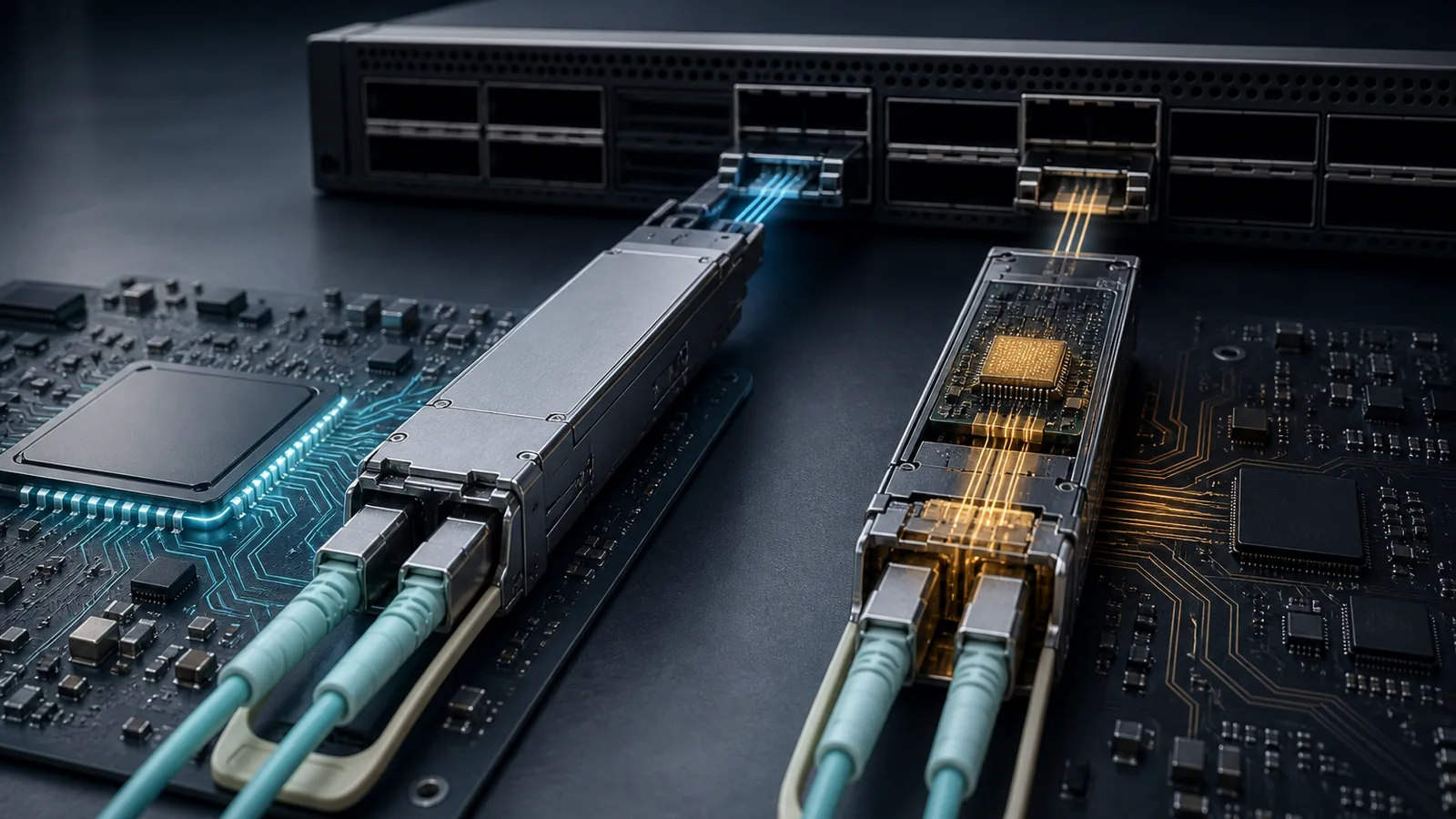
An LPO quotation can look deceptively familiar. It may list 800G, a pluggable form factor, an optical reach and a connector that match the planned link. That resemblance does not make an LPO module a lower-power drop-in replacement for every conventional 800G optic. Removing the digital signal processor from the module changes where signal conditioning is performed, how much the host matters, what evidence a supplier must provide and how the link should be qualified.
This is the practical distinction for a buyer: a DSP-based pluggable is purchased primarily as a module with a defined host electrical interface and optical interface, while an LPO purchase is closer to qualifying a host-channel-module system. The physical module remains replaceable, but more of the electrical-link outcome depends on the switch ASIC SerDes, the board channel, the cage and connector implementation, host tuning, module analog behavior and software support working together.
LPO can be attractive where an approved platform and a controlled deployment let the operator pursue lower module power and a simpler signal path. A DSP-based module can be the more manageable choice where hosts are mixed, operating conditions are less controlled, established interoperability is more important, or the organization cannot support a wider system-level qualification. Neither architecture wins by label alone. The correct decision comes from matching the architecture to a named host, link definition and operating model.
Two signal paths, two ownership models
In a conventional DSP-based 800G pluggable, the high-speed electrical signal travels from the switch ASIC through the host board and connector into the module. A module DSP performs digital signal processing before the module's optical transmit path, and the receive path uses corresponding processing before returning the signal to the host. Implementations differ, but the DSP commonly provides retiming and compensation functions that help the module manage impairments at its electrical interfaces.
In a linear pluggable optical module, the module DSP is removed from that path. Broadcom's own architecture description says LPO and LRO approaches attempt to remove the DSP inside the optical module while the pluggable electrical path still has interconnect losses. That is why the phrase “DSP-less module” should never be translated into “signal-conditioning requirements disappeared.” The requirements moved. The host SerDes and the combined electrical channel now carry more responsibility, while the module's linear transmitter and receiver behavior must remain suitable for that host.
The purchasing consequence is larger than a component substitution:
| Decision area | DSP-based pluggable | LPO | What procurement should request |
|---|---|---|---|
| Signal-conditioning location | Substantial compensation is implemented inside the module | Module DSP is removed; host and linear module operate as a more tightly coupled channel | Architecture declaration and named host support |
| Host dependence | Still host-dependent, but the module DSP can isolate or compensate for part of the electrical path | Usually more sensitive to host SerDes capability, board loss and tuning | Host model, port type, software release and approved-module evidence |
| Power proposition | Includes module DSP power | Intended to reduce module power by removing that DSP | Maximum and typical module power under stated conditions; system-level measurement plan |
| Qualification unit | Host plus module plus optical path | Host channel plus module plus optical path, with tighter attention to electrical conditions | Test matrix that identifies ports, units, lots, temperatures and settings |
| Management | Management behavior depends on the module and host implementation | Management remains essential even without a module DSP and may expose architecture-specific controls | CMIS revision, memory map, alarms, telemetry and host-software behavior |
| Troubleshooting | Module telemetry and DSP diagnostics may help isolate problems | Fault isolation may require stronger host-side visibility and correlated electrical/optical evidence | Counter set, diagnostic access, escalation owner and replacement workflow |
The table is not a claim that every DSP module behaves alike or that every LPO has the same limitations. It shows which questions change ownership. A serious request for quotation should identify that ownership before price comparison begins.
Host eligibility is the first gate, not the last checkbox
The safest starting question is not “Does this fit an 800G port?” It is “Does the platform vendor explicitly support LPO on this exact system, port configuration and software release?” Arista, for example, explicitly lists Linear Pluggable Optics support for its 7060X6 series. That statement is meaningful because it is attached to a named platform. It is not evidence that any other OSFP or QSFP-DD host supports LPO, and it is not a blanket approval for an arbitrary third-party module on the 7060X6.
A cage can accept a module mechanically while the electrical channel remains unsuitable. A host may also support LPO only on certain ports, line rates, module classes, operating modes or software versions. Before requesting samples, the buyer should collect:
- Exact chassis or fixed-system model, hardware revision and switch ASIC where documented.
- Port type, port number or port group, intended line rate and breakout mode.
- Network operating-system release and any required firmware or profile.
- The host vendor's LPO support statement, compatibility guide or qualification note.
- Required electrical interface behavior, link-training or equalization expectations, if published.
- Cage power limit, airflow direction, ambient envelope and thermal policy.
If the host vendor does not state support, do not let a matching MSA outline close the gap. Record the combination as unverified and decide whether the project can fund a controlled engineering evaluation. A supplier may help assemble evidence, but it cannot turn an undocumented host capability into a platform-vendor guarantee.
Define the optical link before comparing architectures
“800G LPO” and “800G DSP optic” are architecture descriptions, not complete link specifications. The buyer still has to define what the two endpoints must exchange over the fiber. The request should state the optical interface or PMD, reach, fiber type, connector, lane mapping, FEC expectation and whether the link is native 800G or a breakout application. Both ends should be named.
This prevents a common comparison error: one offer may describe an 800G module with a parallel optical interface, while another may use a different optical lane arrangement or a dual-interface application. Both can have “800G” in the description without being alternatives for the same cabling plant or far-end device.
Use an endpoint-pair record rather than a one-line module request:
| Field | End A | End B |
|---|---|---|
| Host vendor and model | ||
| Hardware and software release | ||
| Port and configured speed | ||
| LPO support status | ||
| Module form factor | ||
| Optical interface / PMD | ||
| Connector and fiber type | ||
| Link length and patching | ||
| FEC and breakout mode |
The form forces two important facts into view. First, a link can pair unlike form factors when the optical interfaces are intentionally interoperable; the mechanical package at one end does not by itself define the far end. Second, LPO eligibility must be considered independently at each endpoint. An approved LPO host at End A says nothing about End B.
Treat the power claim as a measurement question
The architectural reason for interest in LPO is clear: removing the module DSP is intended to reduce module power. Broadcom describes that objective in its comparison of DSP pluggables, LPO/LRO and co-packaged optics. However, a buyer should resist converting the architecture into a universal watts-per-port promise.
The useful comparison is specific to the candidate modules and host. Ask for declared maximum and typical module power, the conditions behind “typical,” case-temperature limits and required airflow. Then measure at the system level under a test load that represents the intended deployment. A lower module rating may change fan behavior, inlet-to-outlet temperature rise or chassis power, but those effects depend on the platform. Conversely, host-side settings or a different thermal policy can consume part of the expected benefit.
Keep three figures separate in the decision record:
- Supplier-declared module power, with operating conditions and document revision.
- Host-reported or bench-measured module power, with the measurement method and uncertainty.
- Whole-system power, compared under the same traffic, port population, airflow and ambient conditions.
Only the third figure answers a facility-planning question. The first two remain useful for screening and thermal design, but they should not be presented as measured site savings.
Management still matters when the module DSP is gone
Removing a DSP does not remove the need to identify, configure and monitor a pluggable module. OIF's Common Management Interface Specification defines a management framework for pluggable modules, and OIF describes CMIS as a family of documents that works with form-factor and application-specific extensions. The management revision and implemented features therefore belong in the qualification package.
For each candidate, obtain the supported CMIS revision and a readable memory-map or management specification. Confirm what the host displays for vendor identity, module state, temperature, supply voltage, transmit and receive measurements, alarms, thresholds and lane status. If the design requires host-side controls for the linear interface, document who sets them, whether they are automatic, and whether a software upgrade can change them.
Do not assume that two modules exposing CMIS will present identical diagnostics or that the host will interpret every field in the same way. “CMIS compliant” is a starting point for management interoperability, not proof that the operational workflow is identical. During the pilot, capture both the raw module information and the host's rendered output. That gives operations a baseline for future fault isolation.
Build a fair LPO-versus-DSP qualification
A credible evaluation should compare complete links under controlled conditions, not a single module inserted into an idle port. The plan below avoids prescribing universal thresholds; pass limits should come from the host vendor, applicable interface specification and the organization's own service requirements.
Establish the test question before samples arrive
Choose what the trial is meant to decide. It may be a technical feasibility gate, a power comparison, a second-source approval or an operational-support review. Define the candidate host, topology, fiber plant and software release, then freeze them for the comparison. If several variables change at once, the result cannot be attributed to the module architecture.
Use more than one port, unit and manufacturing lot
A successful link on one favorable channel proves little about population behavior. Sample across the port locations that represent the deployed chassis, including channels the platform owner considers electrically or thermally challenging. Where the commercial scale justifies it, include multiple module units and more than one lot. Record serial number, hardware revision, firmware or management revision, lot code and port for every run.
Verify initialization and recovery, not only steady state
Measure cold start, warm restart, module insertion, port disable/enable and relevant host reload behavior. Observe time to link, repeated-start consistency and the counters or alarms generated during transitions. Include the recovery actions operators are likely to use in production. A link that is stable after manual tuning but fails an ordinary restart has not met a deployment requirement.
Exercise representative traffic and collect both ends
Run traffic patterns and durations selected by the network owner, with the required FEC and port configuration. Capture pre-FEC and post-FEC indicators where the host exposes them, uncorrected errors, lane-level health, link flaps and module telemetry. Preserve timestamps from both endpoints. A zero displayed error count without test duration, traffic load and counter definitions is not auditable evidence.
Test the operating envelope the site will actually use
The qualification should cover expected inlet temperatures, port population, airflow and fiber loss, plus any approved margin. Monitor case temperature and host thermal behavior rather than assuming that laboratory ambient represents a filled chassis. Optical receive power should remain within the applicable limits at both ends; extra attenuation or patch panels must be represented accurately. Do not invent a harsher corner merely to create a dramatic test, and do not omit the real worst case because it is inconvenient.
Repeat after relevant software or component changes
Because LPO is tightly coupled to the host electrical path and settings, define requalification triggers in advance. A host operating-system update, SerDes tuning change, module hardware revision, optical-engine change or material supplier change may require regression testing. The required scope should be agreed among the platform owner, module supplier and buyer instead of being decided after a field problem.
The output of the pilot should be a signed matrix, not a slide stating “link passed.” Each row should identify the exact host, port, module, far end, fiber path, conditions, test method, threshold, result and evidence file. Exceptions should remain visible.
Compare operational risk, not just laboratory performance
The architecture choice changes how a fault may be isolated after deployment. With a DSP-based module, the module's digital processing and diagnostics can provide one boundary in the signal chain, although diagnostic depth varies. With LPO, the host electrical channel and module analog behavior are more interdependent. Operations may need simultaneous access to host SerDes information, module telemetry and optical measurements to separate a marginal host channel from a module or fiber issue.
Before approval, ask the operations team to walk through four incidents:
- A newly installed link does not come up.
- A previously stable link begins accumulating corrected errors at high ambient temperature.
- A problem follows the module when it is moved, but only between certain port groups.
- A software upgrade changes link behavior without a module replacement.
For each incident, identify the observable counters, allowed swap sequence, escalation owner, evidence to preserve and rollback path. If those steps are unavailable for LPO on the proposed platform, the technical price advantage may be offset by longer diagnosis and a larger spare strategy. This is not a reason to reject LPO; it is a reason to price supportability honestly.
Four buying situations lead to different answers
A new, homogeneous AI Ethernet fabric
LPO deserves serious evaluation when the project controls the switch model, software release, port configuration and optic list from the start. A platform with explicit LPO support, a short standardized optical application and a repeatable qualification environment reduces uncertainty. Procurement can tie approved modules and revisions to the build standard and preserve the pilot configuration as the production baseline.
The approval still should not be generic. It should name the platform, module revision, optical interface, fiber plant and environmental envelope. Expansion purchases should be checked against that record rather than relying on the letters “LPO.”
A mixed installed base
A fleet containing several switch generations, NICs and software trains favors careful segmentation. Some hosts may explicitly support LPO; others may not. A DSP-based pluggable can offer a more practical sourcing path across the mixed estate, but compatibility still needs confirmation for each platform and module.
Do not force a single architecture rule onto every rack. Maintain an approved optics matrix by host family and use LPO only where eligibility and operational evidence exist. This preserves the potential benefit without creating silent exceptions in older equipment.
A limited engineering pilot
An LPO pilot can be valuable even when a broad rollout is not yet approved. The purpose should be to close named evidence gaps: host initialization, electrical margin, thermal behavior, management visibility, power or recovery. Purchase enough traceable samples to make the result informative, and prevent pilot parts from entering production inventory before the decision record is complete.
A multi-year, second-source program
Long-lived deployments need more than an initial pass. Compare suppliers' process-change notification, revision control, lot traceability, end-of-life notice, failure-analysis response and willingness to support regression tests. A nominally interchangeable LPO module with an unannounced analog-component change can create a different risk profile from a part under controlled revision.
DSP-based modules also change over time, so the same controls matter there. The difference is that LPO's tighter relationship with the host can make an electrical or analog change especially important to the approved combination. Put the notification and requalification rules in the commercial agreement.
What belongs in the RFQ and purchase approval
A useful LPO-versus-DSP RFQ should make the supplier answer the same evidence fields for both candidates. Include:
- Named End A and End B hosts, hardware revisions and software releases.
- Port speed, breakout mode, electrical interface and FEC configuration.
- Optical interface, lane arrangement, wavelength plan, fiber type, connector and maximum path loss.
- Module architecture declaration: LPO or DSP-based, with document revision.
- Host support or compatibility evidence, clearly distinguishing platform-vendor documentation, supplier testing and unverified assumptions.
- CMIS revision, management functions, alarm behavior and accessible telemetry.
- Maximum and typical power with test conditions, case-temperature range and airflow requirements.
- Sample revision, production revision controls, lot traceability and process-change notification.
- Qualification report format, raw evidence availability and agreed regression triggers.
- Warranty, RMA triage flow, failure-analysis turnaround and responsibility when a host-module interaction is suspected.
Price the architectures only after exceptions are visible. A low unit quote with an unresolved host-support gap is not comparable to an approved DSP-based option. Likewise, a DSP-based module should not receive an automatic premium without evidence that its operational or interoperability value matters in the named project.
Make the decision reversible
The most robust approval is one that leaves the next engineer enough information to reproduce or reverse it. Store the signed test matrix, host documentation, module data sheet, management dump, software version, raw counters, thermal and power method, photos of labeling, supplier declarations and approved revisions together. Map each production lot back to that approval.
Define the fallback before rollout. It may be an approved DSP-based module for the same optical interface, a limited set of LPO-qualified ports, or a controlled return to the prior software release. Confirm that the alternative is physically, optically and operationally valid; a fallback name on a spreadsheet is not useful if it requires a different cabling plant.
This discipline also stops architecture marketing from outrunning evidence. LPO is a meaningful design option when the host is built and supported for it. DSP-based pluggables remain a meaningful option when the deployment needs their signal-conditioning boundary or broader established support. The buyer's job is to qualify the complete link and preserve the conditions under which it passed.
Information to send for an evidence-based recommendation
To compare LPO and DSP-based 800G optics for a real project, provide the host vendor and exact model at both ends, hardware and software revisions, intended ports and breakout mode, optical interface and reach, connector and fiber plant, expected ambient and port population, and the candidate module data sheets. State whether the goal is power reduction, a new-platform qualification, second sourcing or replacement in an installed fleet.
Treat OSFP versus QSFP-DD as a separate cage/form-factor decision, not evidence for or against LPO. Use the sample validation plan to turn the architecture decision into a signed test record.
PhotonVerge can then return an evidence-gap matrix and a sample-validation outline. The response should separate documented host support, supplier-held test evidence and items that still require customer-side validation. It should not promise compatibility before the endpoint pair and acceptance criteria are known. Send the host and candidate-module record for review.
Primary sources
All dynamic web sources below were last checked on 11 August 2026. The current host support record and candidate data sheet remain controlling for any future product claim.
- Broadcom — Co-Packaged Optics overview — primary vendor explanation of the electrical path in DSP pluggables and the LPO/LRO objective of removing the module DSP.
- Broadcom — BCM87800 optical DSP product page — primary vendor reference for a DSP implementation; use only for architecture context, not a universal feature claim.
- Arista — 7060X6 Series 800G Data Center Switches data sheet — primary platform evidence that this named series supports LPO; not evidence for other hosts or arbitrary modules.
- Arista — Optics Modules and Cables data sheet — primary platform-vendor reference for its supported optical module portfolio and host-specific qualification context.
- OIF — Implementation Agreements: CMIS Revision 5.4 — standards-body directory identifying CMIS 5.4 (May 2026) as the current published implementation agreement at this draft date.
- OIF — CMIS: Path to Plug-and-Play white paper — February 2025 standards-body explanation written around CMIS 5.3; useful for management architecture, not evidence that 5.3 remains the current revision.